
The report looked good. Not perfect, perhaps, but good enough to make someone in the room smile. AI visibility was up.
For a business owner who has spent years worrying about Google rankings, website traffic, reviews, leads and all the other measurements that seem to multiply every few years, this sounds like progress. Another part of the digital world has been measured, put into a dashboard and given a number.
You can imagine the natural conclusion: we are becoming more visible in AI. Maybe ChatGPT is finding us more often. Maybe Google’s AI results are paying more attention. Maybe the work we have been doing on the website is beginning to show up somewhere important.
Then someone asks a simple question: What, exactly, went up?
That question turns out to be much more interesting than it sounds. Was the company mentioned more often? Was its website cited more often? Did information from the site actually help shape an answer? Did the content become more likely to make it into whatever collection of material the AI system was considering? Did more people discover the business afterward?
Those things sound related because they are related, but they are not the same thing. And that is where the subject of AI visibility becomes more useful than the dashboard number itself.
The Number and the Story We Tell About It
Business owners have always had to live with imperfect measurements. A rise in website traffic does not necessarily mean more customers. A number-one ranking does not automatically mean more sales. A large social-media audience does not guarantee anyone is listening closely. Over time, though, those measurements became familiar enough that most people developed an instinct for what they meant and what they did not.
AI search is newer, and the measurements are newer with it. That creates an awkward moment: we are getting increasingly precise numbers about a system whose behavior we are still learning how to interpret.
The danger is not that the measurements are worthless. The danger is that we ask them to tell a bigger story than they actually can. Suppose a local business is suddenly cited more often in a set of AI answers. That is useful information, but it does not automatically mean the business has become more influential in those answers, that the company name appeared more often, that more people found the website, or that more customers walked through the door.
The problem begins when an observation quietly turns into a conclusion. One number changes, and before long it has acquired a narrative. The interesting question with AI visibility is whether that narrative is justified.
Imagine a Journalist at Work
A useful way to think about this is to forget AI for a moment and imagine a journalist preparing a story.
They may discover your website while doing research, read something useful on it and place it among several possible sources. Later, they may quote from it, use an idea from it without emphasizing where it came from, mention your business by name, or write something compelling enough that a reader eventually visits your website.
Those events can all be connected, but nobody would reasonably say they are identical. Simply being among the journalist’s research materials is not the same as being quoted. Being quoted is not the same as becoming the central authority in the article. Being mentioned is not the same as receiving a new customer.
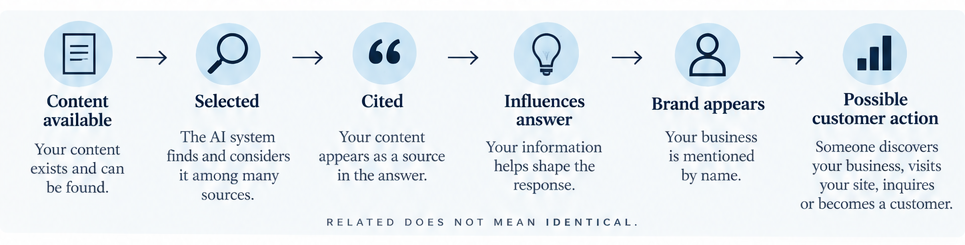
AI search creates a similar chain of possibilities. A piece of content can become available to a system, survive some process of selection, appear as a citation, contribute information to the answer, produce a brand mention and perhaps eventually lead to some kind of discovery or business result.
The mistake is assuming that because we can see one part of that path, we therefore know what happened at every other part. That is what the research behind this article kept bringing me back to: not a clever new trick for improving AI visibility, and not a magic score, but something more basic—understanding what each measurement actually allows us to claim.
AI visibility journey
Sometimes Improving One Thing Can Complicate Another
One controlled generative-search benchmark produced a result that is worth sitting with. Changes intended to improve visibility in AI answers sometimes made documents less likely to reach the answer stage in the first place.
That does not mean the same thing happens universally in Google, ChatGPT or Perplexity. The research was a controlled benchmark, and it should be understood within that boundary. But the finding is valuable because it interrupts an easy assumption.
We tend to imagine optimization as a ladder: make the content better for AI, move up a rung, become more visible, get cited, get mentioned and eventually get discovered. The real system may not be that tidy. A change that helps at one stage can behave differently at another.
Once you see that possibility, the usefulness of a single visibility score begins to look limited. You want to know not merely whether the number moved, but what moved.
A Citation Looks More Definitive Than It Really Is
Citations are especially seductive because they are visible and countable. Your website appears as a source. There it is. That feels substantial, and it is substantial.
But there is still a question hiding underneath it: how much did that source actually matter to the answer?
Imagine an AI response supported by several sources. Your site appears in the citation list, but most of the explanation came from somewhere else. Now imagine another response in which the central idea, explanation or evidence came largely from your material. Both situations may show a citation, but they are not necessarily equivalent.
Research examining the difference between citation selection and what researchers call citation absorption makes this point directly: citation counts alone do not tell us how a source informed the answer.
That distinction may sound academic until you turn it around and ask what a business owner is actually entitled to say. If your business receives more citations, you can say that you received more citations under the conditions being measured. That is already useful. The trouble begins when that statement quietly becomes, “Our content is now more influential.” Maybe it is. But the citation count itself did not prove it.
Even Being in the Room Does Not Mean Your Name Gets Mentioned
There is another wrinkle. A source can apparently be part of the material considered without the brand itself becoming visible.
An observational study of a defined Chinese-language generative-search platform and query sample found that presence in a citation pool did not necessarily result in a brand mention. Again, this is not a universal conversion rate for AI systems everywhere. The study had a specific environment and sample.
But it reinforces the larger point. A business can participate in the information behind an answer and still remain largely invisible to the person reading it. That is a strange concept if you come from traditional search, where visibility usually means the user can see you somewhere on the page. In AI search, there can be more layers between the information and the person asking the question.
That makes measurement more subtle, and it also makes the language we use more important. “Visible” can mean several different things.
Then the Question Changes—and So Does the Picture
There is another complication that has nothing to do with websites at all. It has to do with us, and more specifically with the way we ask questions.
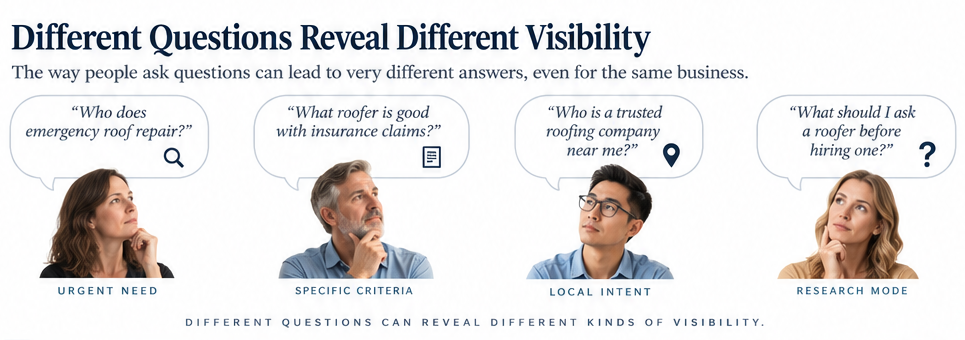
Ask a person where to eat dinner and you might get one answer. Ask where to find a quiet Italian restaurant suitable for a business conversation and you may get another. Ask for the best restaurant for a family with young children and the answer changes again. The same broad subject can produce very different recommendations depending on the question.
AI visibility has this problem too. Research on prompt wording and brand visibility found enough structure in those differences to support tracking a portfolio of prompts, while also finding that sensitivity varied by prompt type and by where the question sat in the customer journey.
The study was exploratory and commercially affiliated, and its findings may depend on the model, prompt set and measurement setup. Still, the practical lesson is easy to understand: if you are measuring whether a business appears in AI answers, the questions you choose become part of the measurement.
That means a company can look highly visible under one group of prompts and much less visible under another. Neither result is necessarily false. They may simply be looking at different slices of the same world.
Different questions / different visibility
This Is Where the Subject Becomes Useful for Business Owners
The lesson is not that AI visibility is hopelessly complicated. The lesson is that it becomes easier to understand once we stop asking one giant question.
Instead of simply asking whether a business is visible in AI, we can begin to separate the problem. Where are we showing up? Are we being cited? Are we actually mentioned? Does our information appear to shape the answer? Does anything seem to be changing beyond the AI result itself?
That is a much more useful conversation because it makes the business owner less dependent on a mysterious score. A dashboard can say 72. Fine. But 72 of what? Compared with what? Measured using which questions? And what does that score actually allow us to conclude?
Those are not skeptical questions. They are management questions. They are the same kinds of questions a business owner should ask about any important metric.
The Most Dangerous Part of a Dashboard Is the Story We Attach to It
There is nothing wrong with dashboards. Most businesses need them. The problem appears when a neat visual creates a false sense that the underlying meaning is equally neat. A chart rises from left to right and we feel progress. A percentage turns green and we feel success. The human brain loves a clean story. AI search may not always give us one.
One of the academic reviews behind this article makes another useful boundary clear: controlled gains in citations do not establish durable gains in organic discovery or traffic.
That is worth emphasizing because it brings us back to what most businesses actually care about. At some point, visibility is supposed to matter outside the visibility report. People discover the company, visit, inquire or buy. But we should not jump from the first observation to the last outcome simply because we want the chain to be complete.
Sometimes the most accurate conclusion is simply that we have evidence one part improved, while we still do not know what happened after that. That may be less exciting than a sweeping conclusion. It is also more credible.
What I Would Want to Hear in a Business Meeting
If someone told me a company’s AI visibility had doubled, I would not dismiss the report. I would be interested.
Then I would want to understand what visibility meant in that particular report, what was actually measured, which questions were used and whether those questions stayed reasonably consistent. I would want to know whether citations were being counted separately from brand mentions, whether there was any indication that the source actually influenced the answer, and whether there was separate evidence of anything happening outside the AI result itself.
Those questions are not designed to turn a business owner into an AI researcher. They are designed to prevent a measurement from becoming mythology.
That matters because we are entering a period in which businesses will be presented with more and more AI metrics. Some will probably become useful standards. Some will disappear. Some will be meaningful only in certain contexts, and some will become impressive numbers searching for an explanation. The companies that understand the difference will be in a better position to learn from the data rather than simply admire it.
The Question Behind the Question
After working through the evidence behind this article, I keep coming back to one sentence: What does this metric actually prove?
That question is useful far beyond AI. It is one of the best questions anyone can ask about data. A measurement has value when we understand its boundary. It becomes dangerous when we allow it to answer questions it never measured.
AI visibility is no different. If your website is being cited more often, that may be progress. If your brand is being mentioned more often, that may be progress. If your content is influencing answers more clearly, that may be progress. If more people are discovering the business, that may be progress too. But those are different kinds of progress.
For now, the smartest approach may be a fairly simple one: measure what we can, name it accurately, keep the conditions reasonably consistent, watch what changes, and resist the urge to turn one promising signal into the whole story.
That may not make for the most dramatic dashboard. But it may make for much better decisions.
The Research Behind This Article
The article above is my interpretation and synthesis of five pieces of research. None of them alone establishes a universal model of how Google, ChatGPT, Perplexity or every other generative-search system behaves. Their value here is in the distinctions they help reveal.
1. SAGEO Arena
Sunghwan Kim, Wooseok Jeong, Serin Kim, Sangam Lee and Dongha Lee, February 2026.
In a controlled generative-search benchmark, changes intended to improve AI-answer visibility sometimes made documents less likely to reach the answer stage. The study supports measuring retrieval, reranking and citation separately, but it does not establish the same effects universally in production systems.
Preprint: https://arxiv.org/abs/2602.12187
DOI: https://doi.org/10.1145/3770855.3818146
2. Prompt Tracking — Wording Variation and Brand Visibility
Jan Ehrlinspiel, Malte Landwehr and Tomek Rudzki / Peec AI, July 2, 2026.
This observational study found that wording effects were structured enough to support portfolio-based prompt tracking, while sensitivity varied by prompt type and funnel stage. It is an exploratory working paper with commercial affiliation, and results may depend on model versions, prompt sets and measurement setup.
Source: https://papers.ssrn.com/sol3/Delivery.cfm/6914539.pdf?abstractid=6914539&mirid=1
3. Chinese-Language Generative Search Audit
July 2026.
The study found that being present in a citation pool did not necessarily result in a brand mention. Its findings concern a defined Chinese-language platform and query sample and should not be treated as a universal conversion rate.
Preprint: https://arxiv.org/abs/2607.15771
4. Citation Selection Versus Absorption
April 2026.
This research distinguishes being selected as a citation from the degree to which a source actually informs the generated answer. Citation counts alone do not show how a source influenced that answer. The paper proposes a measurement framework, and its sample does not establish universal engine behavior.
Preprint: https://arxiv.org/abs/2604.25707
5. Optimizing Visibility in Generative Engines
Martinez, July 2026.
This academic review supports caution in treating controlled citation gains as proof of durable organic discovery or traffic gains. It is a synthesis of selected and changing literature rather than a new field experiment.
Preprint: https://arxiv.org/abs/2607.14035
Where the Evidence Stops
The research used here does not establish one universal AI visibility score, an ideal number of prompts to monitor, standard weights for different measurements, a universal conversion rate from citations to brand mentions, or a guaranteed path from improved AI visibility to traffic or customers.
Those unanswered questions are not a reason to ignore AI visibility. They are a reason to measure it carefully.