01 — Recognizable situations
What needs attention?
- A new customer might not be able to tell from your homepage exactly what you offer, who it is for, or where you provide it.
- Your website, LinkedIn, Google Business Profile and directories describe the business differently — or some descriptions are simply out of date.
- Important claims about experience, quality or results appear without proof a buyer can inspect.
- Key information sits behind logins, inside images or PDFs, or is hard for a crawler to reach at all.
- You have an AI-visibility report in hand and are not sure what it actually proves — or what to do about it.
02 — Foundations
Start with what your business can improve
GEO — generative engine optimization — is the work of making your business’s public information clear, consistent and credible enough for AI answer systems to understand and use. It extends good SEO into answer-based discovery; it does not replace it.
- Accessible information: the facts a buyer — or a machine — needs are on public, readable pages.
- Clear services and relationships: what you offer, and how it connects to who you are, stated explicitly.
- Credible evidence: claims supported by reviews, examples, credentials or references a reader can check.
- Buyer questions answered: fit, process, scope, timing and pricing approach addressed honestly.
- Prioritized improvements: a sequence that fixes the most consequential gaps first.
No single score can pretend to measure all of this, and no page feature guarantees AI citations. What you can improve is the quality of the evidence these systems find.
03 — The work itself
See what the diagnostic work looks like
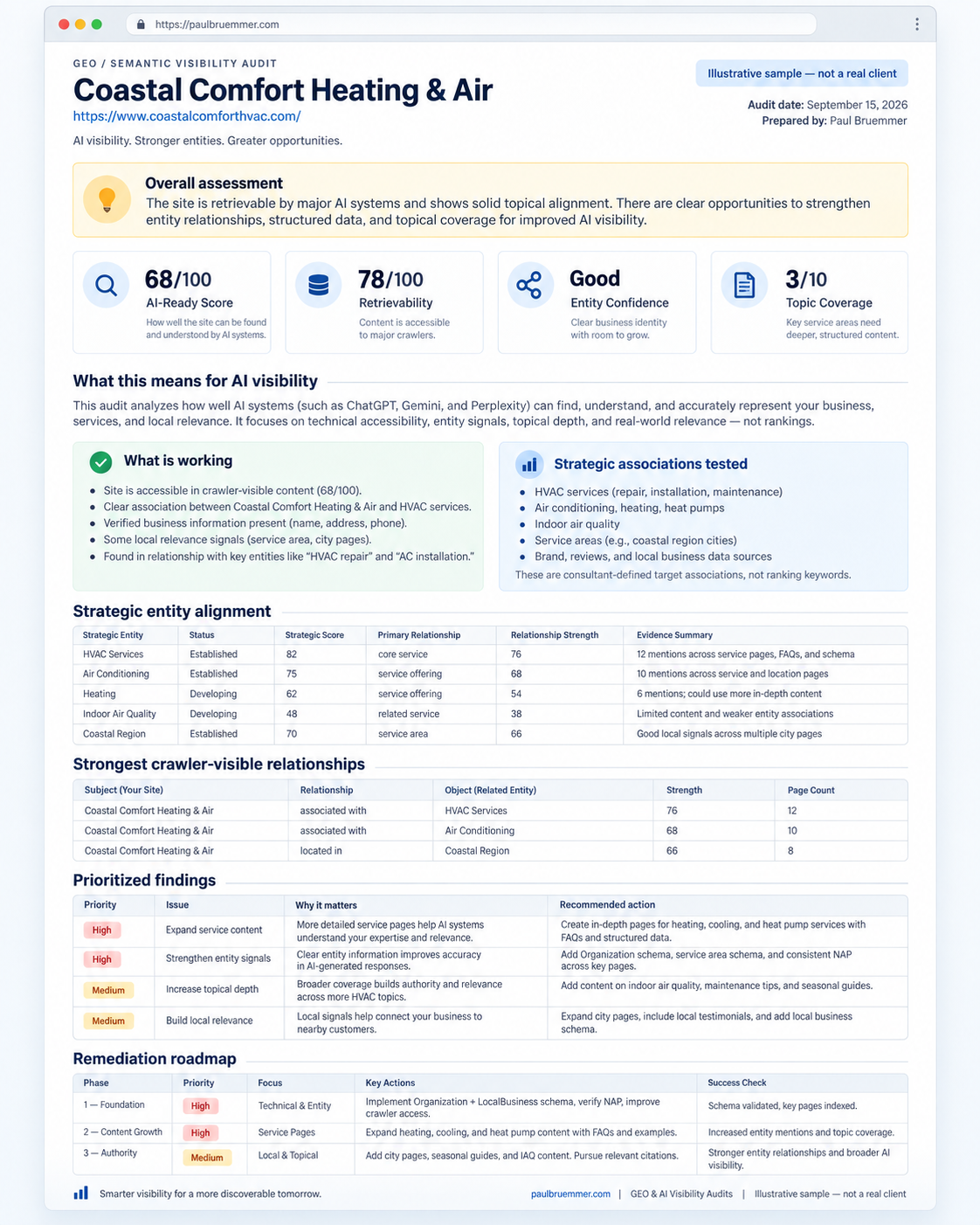
In a scoped engagement I use the Semantic Graph Optimizer (SGO), an internal consulting tool — not a public SaaS product — to examine how clearly crawler-visible evidence establishes an organization, its services and its relationships. The example below is an illustrative sample, not a real client audit.
The scores in a report like this are internal diagnostic assessments — measures of the input a machine has to work with. They are not measured engine citation rates, ranking factors, or business results. Each finding is separated from its interpretation and from the recommended action, so your developer or agency can see what was observed, what it means, and what to do — and not every scoped engagement contains every possible diagnostic.
04 — Starting points
Choose the right starting point
The Machine-Assisted Buyer Clarity Diagnostic is a limited public-evidence assessment of how clearly your business explains itself to buyers. It is not a technical audit, not an AI-visibility measurement, and not an engine retrievability test — but it is a useful way to see where buyer understanding may be breaking down.
If you already know the foundation needs senior diagnosis, the fixed-scope consulting engagement goes deeper. And if you are unsure which fits, a direct conversation is a perfectly good first step — these are alternatives, not a forced ladder.
05 — Further reading
The thinking behind the work
Being Indexed Is Not the Same as Being Understood
What business leaders can reliably do about AI search in 2026 — what the evidence supports, what remains unproven, and how Findable and SGO address different stages.
What Your AI Visibility Metric Actually Proves
AI visibility is becoming easier to measure, but harder to interpret. Here’s how business owners can understand what citations, brand mentions and visibility scores actually tell them—and what they don’t.
Who Checked? What the Confirmation Step Actually Involves
Extraction is nearly solved. The harder work is deciding which discovered facts your organization will stand behind — and building that confirmation in.
If any of this sounds like your situation, — a short message is enough to start.